This is a nighttime 3-shot panorama of Yosemite Falls from top to bottom showing Upper Yosemite Falls, Middle Cascade, and Lower Yosemite Falls. Bob took this from OMG Point, aka Oh My Gosh Rock, a short unpublicized spur trail off the Yosemite Falls Trail.
We are twin brothers devoted to Earth adventures and environmental protection. We've been buddies since we were in utero. We produce videos, in high and ultra-high definition, photographs, articles, and books covering topics on understanding and enjoying National Parks, natural and human history, including native cultures. Our YouTube channel has videos on the above topics. Search Robinson Twins, Richard and Robert. At the bottom of the page, click on Older Posts to see more.
Tuesday, May 17, 2022
Moonbow and Yosemite Falls from OMG Point, Yosemite National Park, California, May 13, 2022
This is a nighttime 3-shot panorama of Yosemite Falls from top to bottom showing Upper Yosemite Falls, Middle Cascade, and Lower Yosemite Falls. Bob took this from OMG Point, aka Oh My Gosh Rock, a short unpublicized spur trail off the Yosemite Falls Trail.
Tuesday, May 10, 2022
A Yellowstone elk female sticking out her tongue
A female elk feeds on clover and licks her lips because of how tasty it is. We saw elk along the road in Yellowstone and this female was right by the road. Clover is a special treat for many herbivores. Elk will migrate out of the park during the winter to seek fresh sources of food at lower elevations and milder temperatures.
Remember, it's not just a picture, it's a story!
Sunday, May 1, 2022
American Dipper in the Yellowstone River
This American dipper, otherwise known as the water ouzel, was traipsing around in the Yellowstone River's Le Hardy Rapids. Dippers feed on the insects that live in rapids, so it can move through the water with little threat of being swept away. They actually walk on the bottom surface of the river and feed on insects that wash down the river or are attached to the rocks. There's a small parking area next to the Le Hardy Rapids and a trail with a deck for visitors to look out over the river. We caught sight of harlequin ducks and pulled off to take pictures of them and the dipper turned out to be a bonus.
Dippers don't get cold in the river water because the have the most wax in their feathers of any songbird. When they dip into the water, their feathers don't get wet at all.
Remember, it's not just a picture, it's a story!
Thursday, April 28, 2022
A cluster of snow plants growing in Lassen Volcanic National Park, California, June 2015
Bob was returning from a trip to McCloud in northern California when he decided to drive home through Lassen Volcanic National Park. This was in June, which is still kind of early in the season for wildflowers in this park. During his drive, he saw this cluster of snow plants near the park road.
Snow plant is a parasitic plant, meaning that it grows off of nutrients that fungi attached to the roots of pine trees make available to it, rather than photosynthesizing. This is why the plant has no green chlorophyll in it.
Remember, it's not just a picture, it's a story.
Wednesday, April 20, 2022
Side-blotched Lizard, male at KCL Campground, Carrizo Plain NM
Thursday, February 24, 2022
Yellowstone cutthroat trout feeding at the surface of the Yellowstone River
The Yellowstone River is famous for its fishing. Yellowstone National Park has a native cutthroat trout that gets its name from the reddish color over the gills. At the north side of Yellowstone Lake, the river emerges and travels north, eventually reaching the Canyon area. Where the river emerges there is a bridge that allows travelers to reach Lake Village. That bridge, from which we captured this image, is appropriately named Fishing Bridge.
Canon EOS 70D, ISO 400, 1/500 sec. f8, 400mm
Remember, it's not just a picture, it's a story!
Monday, February 7, 2022
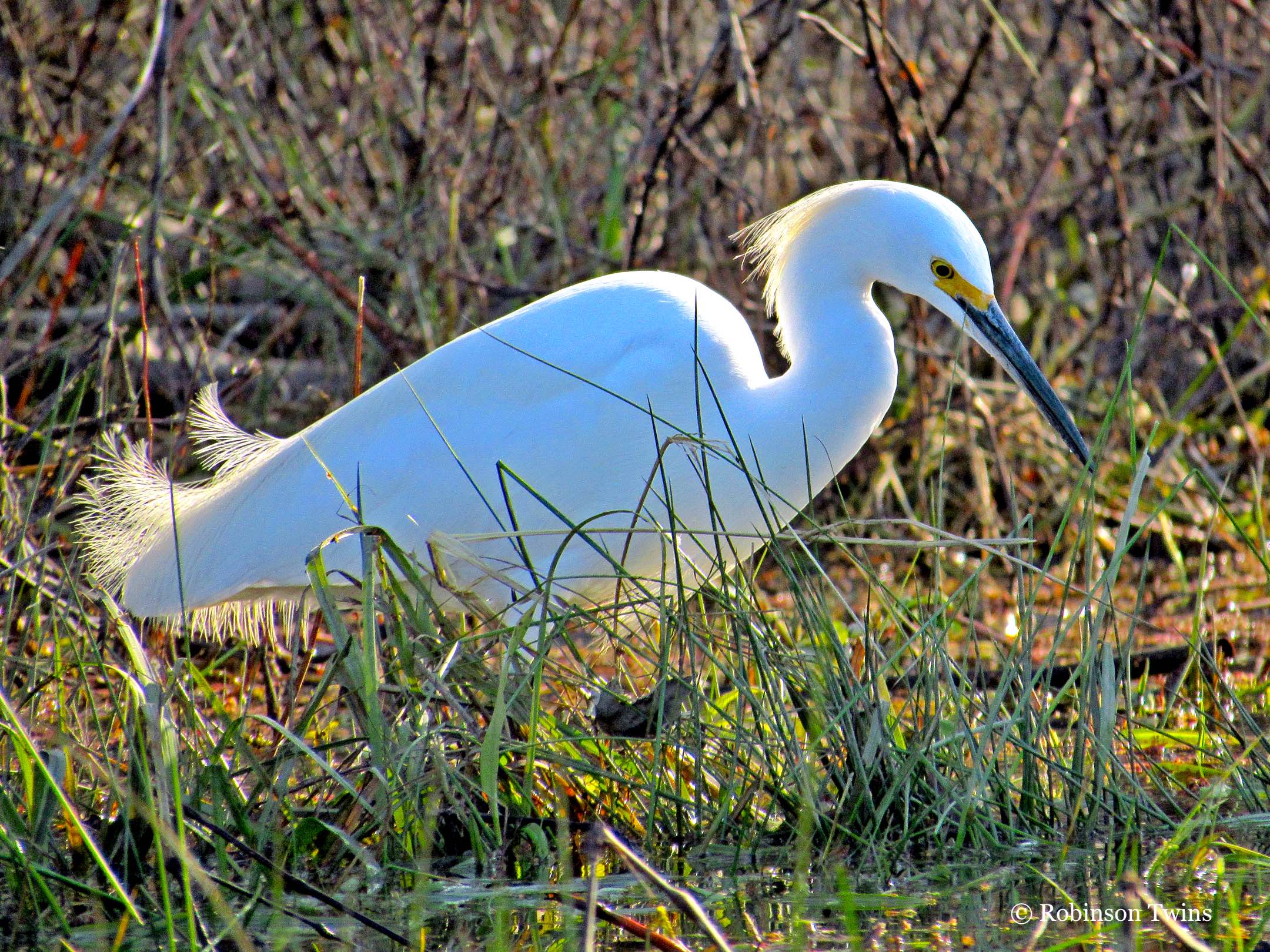
Snowy egret along the American River, Sacramento, California
Rick got these images of snowy egrets, possibly the same one, but in different spots, while we were pedaling in Bob's new-to-him Hobie Mirage tandem kayak.
Snowy egrets are smaller than great egrets and have distinctive yellow feet. Because they are wading birds, it's not always possible to see their feet. Also has what can look like a little yellow mask over its eyes.
Remember, it's not just a picture, it's a story.
Friday, February 4, 2022
Yellow billed magpie, William B. Pond Recreation Area, Sacramento, California
After getting shots of a sea lion in the American River, which we made into a video on our YouTube Channel, Bob continued on his bike ride upriver and encountered a flock of yellow billed magpies at the William B. Pond Recreation Area in Sacramento, California. This is a cropped shot of one of the magpies.
Yellow billed magpies are unique to California. Its more widespread relative, the black billed magpie occurs throughout much of the Western United States, except the Central Valley of California.
Remember, it's not just a picture, it's a story.
Tuesday, January 25, 2022
Ol' Blue Eyes, Montery Coast, California (Brandt's cormorant)
On a SCUBA diving trip to the Monterey Coast, in California, we explored the shore for scenery and wildlife and managed to get pretty close to some Brandt's cormorants. These birds dive underwater and catch fish by extending their necks and catching their prey in a beak that has serrations that point toward the mouth so the fish can't escape. Their feathers are a shiny black and their eyes are blue as you can see in this photo. They can be seen with their wings spread out to dry in the sun.
Remember, it's not just a picture, it's a story!
Wednesday, January 19, 2022
Marbled Godwit and Sanderlings, Monterey, California
Thursday, January 6, 2022
El Capitan and the Big Dipper, May 2018, Yosemite National Park, California
A shot of El Capitan with the Big Dipper in the night sky. El Cap is lit up by a nearly full moon. Bob and Rick were camped at Camp 4 in Yosemite Valley in May 2018 when they decided to take a drive around the Valley enjoying seeing the key landmarks lit up by the nearly full moon.
Remember, it's not just a picture, it's a story.
Friday, December 17, 2021
Beavertail cactus blossom in Arizona
During our Spring Break 2017 trip through Utah and Arizona, Bob got this photo of a beavertail cactus in bloom. Notice a little fly on one of the petals.
Tuesday, December 14, 2021
California Condor over Horseshoe Bend, Page, Arizona
Bob was just looking through his folder covering our trip during Rick's spring break in 2017 and came upon this image of a tagged California Condor flying over Horseshoe Bend near Page, Arizona. Condors have been reintroduced to the Vermilion Cliffs area in northern Arizona and this female is probably from that reintroduction. You can see the tags on this condor on the front edge of each wing. Also, on the left wing, on the right as you look at this photo, you can see the antenna of a transmitter. This condor was Number 53, which turned out to be a five-year-old female, according to The Peregrine Fund researcher that we ran into later in the trip.Not that long ago, only 22 condors were left in the world, but thanks to captive breeding and reintroductions, there are now over 200 in the wild.