Showing posts with label Sacramento. Show all posts

Monday, February 7, 2022

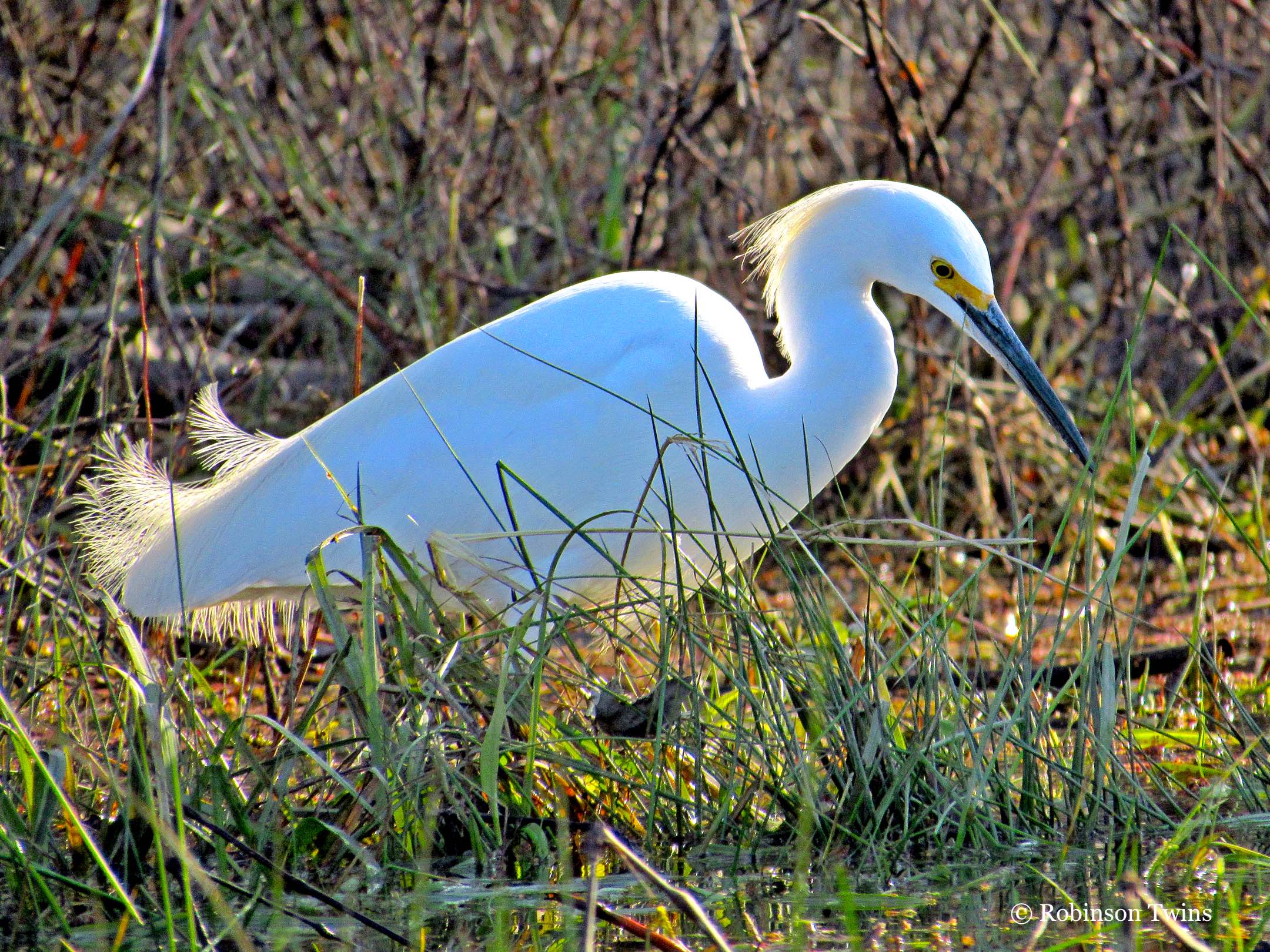
Snowy egret along the American River, Sacramento, California


 Rick got these images of snowy egrets, possibly the same one, but in different spots, while we were pedaling in Bob's new-to-him Hobie Mirage tandem kayak.

Snowy egrets are smaller than great egrets and have distinctive yellow feet.  Because they are wading birds, it's not always possible to see their feet.  Also has what can look like a little yellow mask over its eyes.

Remember, it's not just a picture, it's a story.

Friday, February 4, 2022

Yellow billed magpie, William B. Pond Recreation Area, Sacramento, California


 After getting shots of a sea lion in the American River, which we made into a video on our YouTube Channel, Bob continued on his  bike ride upriver and encountered a flock of yellow billed magpies at the William B. Pond Recreation Area in Sacramento, California.  This is a cropped shot of one of the magpies.

Yellow billed magpies are unique to California.  Its more widespread relative, the black billed magpie occurs throughout much of the Western United States, except the Central Valley of California.

Remember, it's not just a picture, it's a story.

Sunday, January 24, 2021

Red-eared slider, turtle basking on a log in the American River


In the Sacramento area, we love visiting the American River that flows right through the city and joins the Sacramento River just north of the historic Old Sacramento. It's amazing how much wildlife we see inside the city limits. Here we saw turtles that are not native to California, the red-eared slider. A group of the turtles were basking on a log as we were canoeing nearby. The turtles noticed us and were acting a little more alert as we got the cameras out.

Canon PowerShot 530HS, ISO 400, 215mm focal length, 1/250 sec, f8

Remember, it's not just a picture, it's a story!

Saturday, August 1, 2020

Comet NEOWISE over Old Sacramento, California


It might be hard to make out in the first photo, but Comet NEOWISE is in the right upper center of this image between the building and the flag pole on the bow of the riverboat. This image is from Old Sacramento State Historic Park in Sacramento, California. The riverboat in the foreground is the Delta King, which acts as a floating hotel and is permanently moored at its dock. The building in this image is on the other side of the Sacramento River in West Sacramento.

Bob took these photos on the evening of July 17, 2020.  In the first photo the lights on the riverboat were so bright that it produced a sharp contrast with the night sky where the comet was.  To reduce the contrast he used a graduated neutral density filter to tone down the riverboat lights.

The second photo is a zoom-in showing the comet and its position relative to the building in the first photo.

Sunday, July 12, 2020

Comet NEOWISE over Sacramento, California


These photos are of Comet NEOWISE, aka C/2020 F3, taken at about 4:39 AM Sacramento time on July 12, 2020. I, Bob, had driven to the west end of the Yolo Bypass, which is between the cities of West Sacramento and Davis, California. I was looking northeasterly when I took this shot.  Other photographers were out in these predawn hours to get photos of it, like I was. The horizon is the Sierra foothills.

At this point Comet NEOWISE is on the outbound part of its orbit after already whipping past the sun. The tails of comets are created by and directed by solar radiation, which means they always point away from the sun. The sun is below the horizon in this view and the tail is pointing away from it.

While I was getting shots of the comet, a freight train passed by me on the nearby tracks.

Remember, it's not just a picture, it's a story.

Wednesday, July 1, 2020

Female common mergansers resting on a log, American River Parkway, Sacramento, California


We were out paddling around the American River Parkway in Sacramento, California when we encountered these female common mergansers resting on this log that had fallen across this channel.  This is just downstream from the Watt Avenue Bridge.

The merganser in the middle had its mouth open, while the merganser on the right was giving us the eye while trying to get some sleep.  Mergansers are also known as fish ducks, since they feed on small fish by diving underwater and swimming after their prey.

Remember, it's not just a picture, it's a story.

Monday, May 13, 2019

Bewick's Wren in Bob's backyard


Bob went into his backyard and heard this bird buzzing around, so he grabbed his camera and waited for the little guy to perch in an open spot.  Eventually during his flitting around, he perched on this camellia branch where Bob could get a clear shot of him.

Bob suspects that this little guy is nesting somewhere nearby.  Bewick's wrens nest in cavities such as old woodpecker holes or where an old branch has rotted out of a tree trunk.

This photo was shot with a 100-400 zoom lens set at 400 mm and is heavily cropped.

Remember, it's not just a picture, it's a story.

Sunday, April 29, 2018

Pacific Crest Trail Association annual meeting April 28, 2018

Rick's October 1982 solo trip on the Pacific Crest Trail, covering the distance of about 70 miles from Sonora Pass to Echo Summit. I bought the pack new and unfortunately didn't consider the hype about it's design. I ended up carrying the entire weight of my gear on my shoulders because the hip belt was nearly useless. After this trip, I got rid of the pack and went back to my older one, which I had kept.
Rick attended the 2018 Annual Meeting of the Pacific Crest Trail Association, in Sacramento. When he worked on the trail crew for the Toiyabe National Forest in the summer of 1982, he got paid to go backpacking out on Mondays and return on Fridays for a couple of months. During that summer, he worked on portions of the PCT, mainly in California's Alpine County. After the seasonal job ended, Rick went back to hike from Sonora Pass to Echo Summit by himself, covering about 70 miles, with most of the trail distance being familiar already.

We have also hiked the Rae Lakes Loop in Kings Canyon National Park, which includes a portion of the PCT. We got a twin selfie shot of us two at the high point of the loop at Glen Pass.

Rick has also hiked a portion of the PCT farther south with a friend, through the Evolution Valley area. We'd like to hike at least the length of the Sierra Nevada soon.

Remember, it's not just a picture, it's a story!

Wednesday, February 21, 2018

Western bluebird, American River, Sacramento, California


A male Western bluebird perched in a tree near the American River Parkway in Sacramento, California.  The flash of blue that they show when flying can be quite eye-catching.

If you enjoy this and other photos in our Robinson Twins online photo gallery, please Follow us.

Remember, it's not just a picture, it's a story!

Tuesday, February 20, 2018

Pintail duck pair, Cosumnes River Preserve, Galt, California


A pair of pintail ducks standing in wetlands along the Lost Slough Wetlands Walk at the Cosumnes River Preserve near Galt, California.  Pintails are distinguished from other ducks by their very pointy tail feathers.  The female has a gray bill, while the male has a blue-gray bill and a brown head with a white stripe running along the back of the neck.

We were visiting the Cosumnes River Preserve hoping to get a close look at the sandhill cranes that winter in the Sacramento Valley, but were certainly willing to photograph any other waterfowl or wading birds that inhabited the wetlands along with them.  Unfortunately, we only saw four cranes flying way overhead heading somewhere other than the wetlands we were visiting.  It was a good visit nevertheless thanks to the abundant birdlife flitting about.

If you enjoy this and other photos in our Robinson Twins online photo gallery, please Follow us.

Remember, it's not just a picture, it's a story.

Tuesday, January 16, 2018

A white black phoebe along the American River Parkway, Sacramento, California


I, Bob, have observed this black phoebe in white plumage for the last couple of months, but today I managed to get my closest and longest look at it.  Black phoebes are normally all black, except for a white belly, but this one is almost all white with a little bit of cream coloring.  Black phoebes are members of the flycatcher family and feed on flying insects by waiting on a perch and then darting out after an insect flying by.

This phoebe's territory seems to be around a drainage pump assemblage about a half mile upriver from the Watt Avenue Bridge along the American River's south side in Sacramento, California.

This photo was taken with a Canon EOS 6D Mark II full frame DSLR with a 100-400 mm zoom lens set on 400 and the resulting photo was heavily cropped to get this final result.

For comparison, I've posted below my heavily cropped photo from the same day of a normal black phoebe, also along the American River.

If you enjoy this and other photos in our Robinson Twins online photo gallery, please Follow us.


Remember, it's not just a picture, it's a story!
Sunday, March 26, 2017

Robinson Twins - American River Parkway

Our first recreational video, The American River Parkway, was video-recorded in 1999 and released in 2000. This part of Sacramento is our home turf, so to speak, so we wanted to make it first. We went to college by walking along the American River, we've biked the parkway's length several times, go jogging along it, and have paddled most of it. For the video, we also flew over it in a small airplane. We hope you enjoy the adventure that's within easy reach of hundreds of thousands of people in Sacramento County, California. Here's the link to our video: https://youtu.be/gmbOhAckfc8

The picture is from our airplane flight and shows Discovery Park and the confluence where the cleaner American River joins the muddier Sacramento River. The closer bridge is Jibboom Street while the larger bridge is Interstate-5. Old Sacramento State Historic Park is nearby to the right of this photo (not shown).


Remember, it's not just a picture (video), it's a story!

Saturday, September 24, 2016

Acorn woodpecker in an oak tree during winter.


An acorn woodpecker stands on a branch of an oak tree in February at Phoenix Park in Sacramento County, California. This area is north of the American River beyond the bluffs. The park has baseball fields but also is home to a rare habitat, vernal pools. Vernal pools form during the winter and as they dry, several plant and animal species go through their entire life cycle to take advantage of the presence of water. For the rest of the year, the ground is dry. Acorn woodpeckers are the only woodpeckers that nest in colonies and feed on acorns.

Remember, it's not just a picture, it's a story!