Showing posts with label California. Show all posts

Friday, June 6, 2025

The Temple, sea arch along the California coast at Point Reyes National Seashore


 The Temple is a sea arch along the Point Reyes National Seashore coastline. Sea arches form by erosion caused by wave action. The Temple is only safe to visit during low tide, because during high tide, the waves can reach the base of the cliffs along the one mile of beach that it takes to reach this arch.

The day was a little overcast, but we arrived here at mid-morning when the tide was going from low tide to high tide. We could tell that the water reaches the arch at those times. DO NOT try to find this arch until low tide, or you could be trapped!


Fuji GFX100S, f13.9, 1/50 sec. ISO 400, 45 mm (36 mm 35 equiv.)

Location: 37 deg, 58' 51.48", -122 deg, 48' 9.68"

            Remember, it's not just a picture, it's a story!

Wednesday, March 5, 2025

Big Sur southern coast, Kirk Creek Arch, Monterey County


We found out about an arch along the southern end of the Big Sur coast from a Facebook posting from an avid hiker we're following. She mentioned where she was and included several photos, including an arch in the Pacific Ocean. It was actually next to a campground we were already thinking about visiting, so her posting made us take the trip to see it sooner rather than later. We saw it first during a higher tide, with waves crashing under the arch. We came back about 6 hours later and the tide was low enough that we could stand under it. We took measurements with a laser measurer and reported our results to the Natural Arch and Bridge Society. It turned out that we were the first to report this arch to them.


Remember, it's not just a picture, it's a story!

Wednesday, January 22, 2025

Alabama Hills, the Eye of Alabama natural arch


Here is a close view of the second most famous feature in the Alabama Hills, the Eye of Alabama. We parked along the road and hiked up to this feature to get a closer image. There are over a hundred natural arches in this area. We visited during the Fall Arch Rally sponsored by the Natural Arch and Bridge Society in November 2024. We were part of a group of about 15 people on this day.

The Paiute name for this area is Payahuunadü, "land of flowing water."

Fuji GFX100S, ISO 100, f8, 1/220 sec., 100 mm (79mm equiv.)

Remember, it's not just a picture, it's a story!

Friday, December 6, 2024

Mobius Arch and the Milky Way, Alabama Hills, Lone Pine, California, November 4, 2024


 We attended the 2024 Fall Arch Rally of the Natural Arch and Bridge Society, which was centered around the Alabama Hills for the first half of the rally. One night we hiked out to Mobius Arch to get some night shots of it, including this light painting of the arch with the Milky Way galaxy overhead.. Mobius Arch is the most noteworthy granite natural arch among many arches in the Alabama Hills near Lone Pine, California.

Remember, it's not just a picture, it's a story.

Mobius Arch silhouette, Alabama Hills, Lone Pine, California, November 4, 2024


 We attended the 2024 Fall Arch Rally of the Natural Arch and Bridge Society, which was centered around the Alabama Hills for the first half of the rally. One night we hiked out to Mobius Arch to get some night shots of it, including this silhouette. Mobius Arch is the most noteworthy granite natural arch among many arches in the Alabama Hills near Lone Pine, California.

Remember, it's not just a picture, it's a story.

Monday, October 28, 2024

Comet C/2023 A3 at Morro Bay, California


View of Comet C/2023 A3 (Tsuchinshan, Atlas) from Morro Bay, California. Rick was camped next to Morro Creek for two nights hoping to get a photo of the comet with Morro Rock, but it was foggy for those two nights. The third morning appeared mostly sunny, so Rick paid for another night hoping for clear skies that night. He was fortunate that it worked out well that time. The nearly full moon helped to light the foreground for this long exposure. The end of Morro Rock and Pillar Rock appear on the left side of the photo.

October 16, 2024, Fuji GFX100S, 20 seconds, 45 mm (36 mm equivalent), f/5.7, ISO 800

You can watch our YouTube video about this project at: https://youtu.be/j-zvldptmLc


Remember, it's not just a picture, it's a story!


Monday, July 22, 2024

Alamere Falls in Point Reyes National Seashore, lit by flashlight at night


We attempted to determine if Point Reyes's Alamere Falls could produce a moonbow during the July full moon period. We hiked along the beach from Wildcat Camp while the tide was changing from high to low. This also was one day before the full moon, which means an earlier start to the moonbow, if it happens. We didn't find a moonbow, but we may have arrived too late. We still have hope that it can happen here. 

While near the base of the falls, we set up our cameras and tried taking moonlit images and light-painted images. Light painting involves using a source of light combined with a long exposure to artificially light up a night-time scene. This one worked out quite well.

Fuji GFX100S: 30 sec, f5.6, ISO 1600, 45mm (36mm equivalent)

Remember, it's not just a picture, it's a story!


Tuesday, February 13, 2024

Harbor Seal hauled out near Point Arena lighthouse, scratching its head


Aw, that's the spot! A harbor seal relaxes on the rocky coast near Point Arena lighthouse. When their bristly fur dries, they look whitish. When wet, the fur looks much darker. This one was part of a group hauled out onto the sedimentary rock layers and relaxing during a warm summer day within sight of the Point Arena lighthouse.  A couple of important differences between seals, such as this one, and sea lions, are: seals - no external ear flaps, sea lions - have external ear flaps; seals- rear feet always point backward and they can't stand on their feet, sea lions - rear feet can rotate to point forward and they can stand on their feet.

Canon PowerShot SX530 HS, 1/1000 sec. 215 mm focal length, f 6.5, ISO 800


Remember, it's not just a picture, it's a story!

Friday, May 19, 2023

Bridal Veil Falls, Highway 50 near Fresh Pond, California


A number of waterfalls are named Bridal Veil Falls with at least two in California.  There's the more famous Bridal Veil Falls in Yosemite National Park and then there's this one along Highway 50 near Fresh Pond.  The highway goes right by this waterfall and there's a broad turnout for travelers to pull off and take in this view.

We stopped off to see this waterfall on Saturday, May 13, 2023.  Since California had gotten a lot of precipitation during a very wet winter season, this Bridal Veil Falls was gushing.

Remember, it's not just a picture, it's a story.

Tuesday, May 16, 2023

Phantom Fall with rainbow, North Table Mountain Ecological Reserve, California


Phantom Fall gets its name because it's seasonal and might not appear at all in dry years. We hiked out to see it the first week of April in 2023. We arrived just at the right time to see this rainbow form in its mist. The North Table Mountain Ecological Reserve, where the fall is located, is north of Oroville, California. The reserve protects a volcanic tableland that is level for the most part, but streams cut deep gorges in some parts. The water drops along the rock wall, then free falls in front of an alcove. There's a steep trail down to the base of the fall and we saw people walking behind the water.

Canon 70d, ISO 100, f13, 1/30 sec, 49 mm,


Remember, it's not just a picture, it's a story!

Friday, May 5, 2023

Indian Lettuce (Miner's Lettuce) at North Table Mountain Ecological Reserve, Spring 2023


This unusual plant has white flowers emerging from the center of a circular leaf. It was used as food by the native California people and the gold miners of the 19th century. So it can be called Indian lettuce or miner's lettuce. Its scientific name is Claytonia perfoliata. These plants are found all over California. I even have it growing in my yard, even though I made no attempt to cultivate it.


Remember, it's not just a picture, it's a story!

Tuesday, January 24, 2023

Valley Oak at sunset, North Table Mountain Ecological Reserve, near Oroville, California


 After an afternoon of hiking in the North Table Mountain Ecological Reserve, near Oroville in northern California, we got back to our vehicle at sunset. Right next to the parking area was this beautiful valley oak, making a silhouette against the bright horizon. We've heard about this place for many years, but this was our first visit and it won't be our last. This visit was in January, so we plan to go back later in the spring when the wildflowers are in bloom.

Taken with a Samsung a52 6u smartphone, ISO 2000, f1.8, 24 mm focal length equivalent, 1/8 sec, using Night Mode without tripod, processed in Digikam and GIMP

Remember, it's not just a picture, it's a story!

Monday, August 8, 2022

Crowley Lake Columns east of the Sierra Nevada in California


These rock columns are along the eastern shore of Crowley Lake, east of the Sierra Nevada, in California. Geologists believe this feature is the result of a lava flow that had rain or snow fall on it while it was still liquid causing the rock to solidify in a somewhat regular pattern. You can see the tops of the columns standing above the ground level. The dark line on the columns indicates the water level of the lake earlier in the season during the spring runoff. The columns appear to be disk-shaped rocks stacked on top of each other and you can see all the disk-shaped rocks from eroded columns make up the shoreline. Getting here required driving a rough dirt road and hiking a steep slope for 200 yards. Others had to park farther away and walk a mile on the road to get here. You can also boat across the lake from the west side to the east side to get here. This is a panoramic shot taken with a Samsung A52 set at ISO set for Auto, f1.8, 24 mm equivalent focal length. Below is a shot with Rick between columns for size comparison. You can see the upper parts of these columns are still in rock matrix while the water from the lake has eroded away the matrix where he's standing.


Remember, it's not just a picture, it's a story!

Wednesday, April 20, 2022

Side-blotched Lizard, male at KCL Campground, Carrizo Plain NM


During my recent visit to the Carrizo Plain National Monument, I camped at the KCL Campground, roughly in the middle of the area. The campground has a healthy population of this species, the side-blotched lizard. The males are more colorful than the females. This male was hiking under a shrub that had a big gap in the middle, so I had a clear view of him. There was also the opening to a burrow being used by a young antelope ground squirrel. As the lizard moved around, he had his tail hanging down across the opening and the squirrel came up and wondered what was going on.


Remember, it's not just a picture, it's a story!


Monday, February 7, 2022

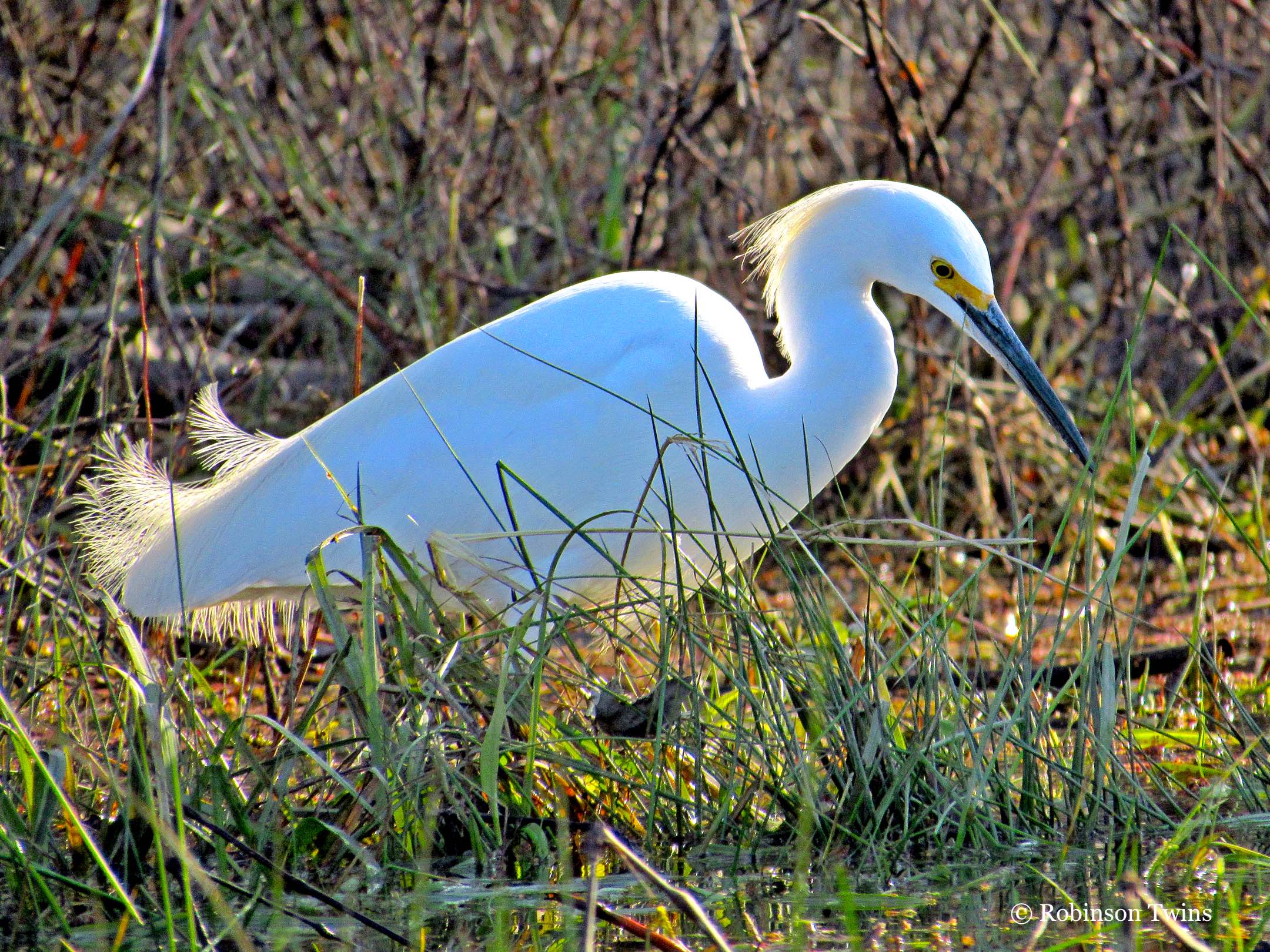
Snowy egret along the American River, Sacramento, California


 Rick got these images of snowy egrets, possibly the same one, but in different spots, while we were pedaling in Bob's new-to-him Hobie Mirage tandem kayak.

Snowy egrets are smaller than great egrets and have distinctive yellow feet.  Because they are wading birds, it's not always possible to see their feet.  Also has what can look like a little yellow mask over its eyes.

Remember, it's not just a picture, it's a story.

Sunday, November 28, 2021

The Eye of Alabama, in the Alabama Hills, west of Lone Pine, California


One of the bigger natural arches in the Alabama Hills is the Eye of Alabama (also labeled as the Eye of the Alabama). This arch looks to me like a left side of a face with a very large eye and the left end being the nose. But that's just me. When you're driving up to it, you might not see it, because it's not at the top of the ridge, but part way down. We got to this feature from a small pullout along the Movie Road and a short trail uphill, then off-trail. You can climb right onto it with a little scrambling. 

Photo details: Canon 70D, 55mm, ISO 200, f/11, 1/180 sec., with polarizer

Remember, it's not just a picture, it's a story!

Tuesday, November 23, 2021

Mobius Arch moonlit at night with Mount Whitney underneath, and Jupiter

Mobius Arch, Alabama Hills, California

 On our trip to the Alabama Hills, which is east of the Sierra Nevada's highest peak, Mount Whitney, I got this nighttime photo of the world-famous Mobius Arch. Mount Whitney is seen underneath the arch to the far right (it's not the highest-looking peak from this view). Mobius Arch is named for the Mobius strip, a mathematical/topological concept of having a single twist in a strip linked to itself such that it has only one side. The thin portion of the arch must've made someone think it had a twist in it, hence the name. 

This feature is along the Arch Loop Trail, a little over 1.5 miles off of Movie Road, which is off of the Whitney Portal Road heading west out of Lone Pine, California. The trail also passes Lathe Arch, Heart Arch, and Behind the Heart Arch. You can see Heart Arch from the parking area before you even start to hike. Mobius Arch is the largest of these with the largest opening and span. Jupiter is brightest object in the sky.

This photo was taken by moonlight at 30 seconds, ISO 1600, f9.5.

Remember, it's not just a picture, it's a story!

Sunday, April 25, 2021

Burney Falls, after midnight, light painting


Burney Falls is a waterfall famous for its unique geology. The stream, Burney Creek, flows over the brink after being split into two streams that fall to the pool below. The rest of the cliff face has springs gushing from it that make it look like a very wide waterfall. The estimated amount of water flowing from this cliff is 100 million gallons per day. We visited McArthur-Burney Falls State Park during spring break 2021. 

In a way, Burney Falls is challenging to photograph in that it is north-facing and doesn't receive direct sunlight. We managed to get a better image of the falls than usual by taking this picture after midnight and using a flashlight combined with a long exposure time to light the scene in a way that couldn't happen during the daytime. This image was actually taken around 12:43am with a 30-second exposure, ISO 800, f5.6, and a focal length of 18mm. It needed a wide-angle setting on the lens to get all of the falls in the frame, plus we wanted to be physically closer so the flashlight could be more effective. This process of using a flashlight (or torch as the British call it) to light the scene is called light painting. It appears to bring out the colors of the ferns better than a daytime photo when the cliff is in shadow.


Remember, it's not just a picture, it's a story!


Tuesday, November 3, 2020

Aspen trees changing to their Fall wardrobe in Hope Valley, California


A bit of fall color in Hope Valley, California.  These are the changing leaves of aspen trees near the junction of Highways 88 and 89 south of Lake Tahoe.

Remember, it's not just a picture, it's a story.

Friday, September 11, 2020

Water ouzel (dipper) in Silver Creek, Alpine County, California


Over the Labor Day weekend, we went to Alpine County, California, an area where Rick worked in the Toiyabe National Forest on the trail crew. There was a fire south of us in Slinkard Valley, so we couldn't stay overnight, but we did get a chance to look at the east fork Carson River where Silver Creek joins it. We found this water ouzel (dipper) bird that lives along river rapids and eats insects that live in the rapids. I happened to catch this image of the bird with an insect in its mouth. This species of bird walks around in the rapids with no apparent concern for its safety. It can even dip underwater when looking for its food and walk on the river bottom. We've even seen these birds dipping into the Merced River in Yosemite, during the winter. It doesn't get cold because it has so much oil in its feathers, it doesn't get wet. 

Remember, it's not just a picture, it's a story!